
Donor Rib Cartilage vs Autologous Rib Cartilage — Which Is Better Long-Term? Selection Criteria When Harvesting Feels Burdensome
2024. 6. 24.
An answer to someone hesitant about autologous rib harvesting and considering donor rib cartilage. That donor rib is a widely used material in nose surgery, the possibility of partial absorption depending on the individual, and why autologous rib is recommended when reversion is the main worry.

Key points
- Both donor rib and autologous rib cartilage can be considered in revision nose surgery — but long-term maintenance and the possibility of absorption or warping differ by site of use and how the material is processed and fixed.
- Autologous rib carries burdens like donor-site scarring and pain, and donor rib also requires separate explanation of its material characteristics and risks.
- Do not choose a material on the worry of "reversion" alone — compare the support strength needed, surgical history, and the burden you are willing to accept.
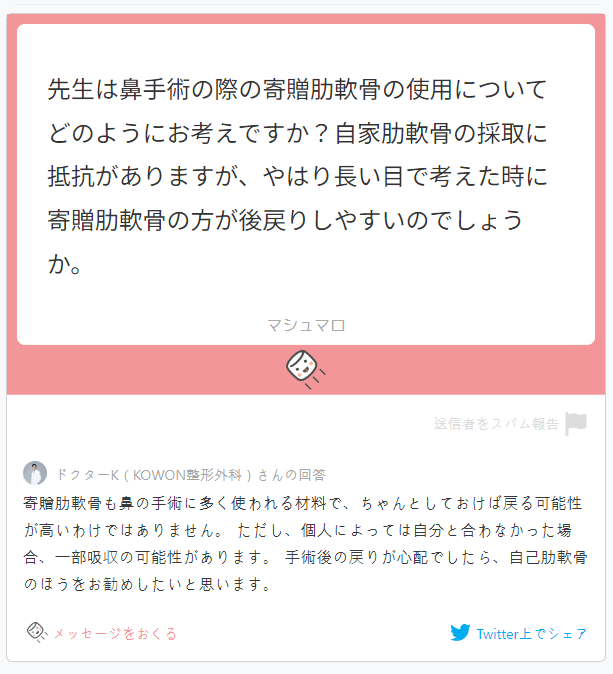
"What do you think about using donor rib cartilage in nose surgery? Harvesting my own rib cartilage feels burdensome — is donor rib the more worrying material in the long run?"
An inquiry from Japan. Autologous rib cartilage felt burdensome because it must be harvested from one's own chest — yet using donor rib raised the worry that results might revert over time. This is a point people looking into rib cartilage surgery commonly ask about regardless of country.
Based on the answer to that question, this article organizes what criteria to weigh between the two materials.
01
Is donor rib cartilage a material to worry about?
The fact that it is donor rib alone does not mean the result necessarily reverts. Conversely, it also cannot be guaranteed that "it lasts as long as it's done properly" — the site of use, the processing and fixation method, and tissue condition must be reviewed together.
Still, there is one thing to know: depending on the individual, if the material does not suit the body, there is a possibility of partial absorption. Because this possibility differs from person to person, it is hard to conclude that donor rib is maintained to the same degree in everyone.
02
If reversion is the worry, which side should I choose?
Organizing around the asker's concern, it looks like this.
| Priority | A choice worth considering |
|---|---|
| Want to reduce the burden of harvesting | Confirm donor rib's material characteristics, absorption, warping, and infection possibilities |
| Want to prioritize autologous tissue | Confirm autologous rib's donor-site scar, pain, and the amount needed |
If the biggest worry is the result reverting after surgery, our answer was that we would recommend autologous rib cartilage. Which weighs more for you — aversion to harvesting or worry about long-term maintenance — becomes the criterion for the choice. How autologous rib cartilage is used can be seen in more detail in the autologous rib cartilage procedure guide.
03
Summary — the priority of your worries sets the material
It is hard to say that either donor rib or autologous rib is always better. Both materials carry possibilities of absorption, warping, and infection along with their pros and cons in use — and autologous rib adds the burden of the donor site. The support strength needed, the site of use, past surgical history, and the burden you are willing to accept must all be weighed together.
Frequently asked questions
Answers to common questions patients ask before a consultation.
If I have surgery with donor rib, will the nose revert?
Autologous rib harvesting feels burdensome — must I use autologous rib?
Can I get a material-selection consultation while overseas?
Responses to treatment and recovery progress vary by individual. Outcomes and side effects vary from person to person. Bleeding, infection, swelling and asymmetry may occur. Please consult our medical team before making a decision.