
If the nose came out high and long after surgery — the two points checked when resetting it short and low
2024. 5. 13.
The two points checked when rhinoplasty leaves a higher, longer nose than wanted — the silicone's starting point (nasal root) height, and the tip's height & angle. Judgment criteria for resetting toward a shorter, lower impression — organized.

Key points
- Why a nose looks long can be thought of split into bridge and tip.
- If there's silicone on the bridge, check whether the starting point (nasal root) sits too high — if high, the nose can read as long and aging.
- A tip that's too high or drooping-feeling can also read long — lowering tip height slightly or raising the angle upward sets a curved impression.
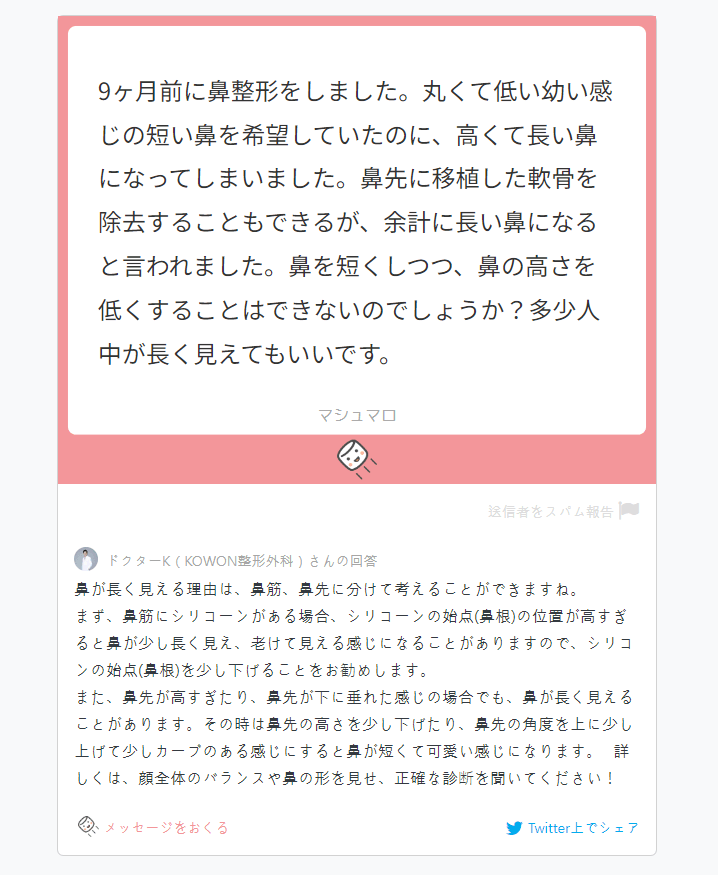
"I had rhinoplasty 9 months ago. I wanted a rounded, not-high, youthful-looking short nose — but it came out high and long. I heard the cartilage grafted at the tip could be removed, but also that doing so could make it look even longer. Isn't there a way to shorten the nose while lowering the height? A somewhat longer-looking philtrum is fine."
A question that came into the KOWON answer notes. Since the result came out opposite the desired direction, the core is where to look again.
01
Where does the long look come from?
Why a nose looks long is hard to judge looking at one spot alone. Broadly it's thought of split into the bridge and the tip. Because each participates in the length impression differently, which side the impression comes from gets distinguished first.
| Where to look | What gets checked |
|---|---|
| Bridge (if silicone present) | Whether the silicone's starting point — the nasal root position — sits too high |
| Tip | Whether the tip is too high, or feels drooped downward |
02
What gets adjusted at the bridge?
If there's silicone on the bridge and its starting point — the nasal root position — is too high, the nose can feel somewhat long and aging. In that case, lowering the silicone's starting point slightly is the recommended direction.
In short, it's less a matter of unconditionally lowering the whole bridge, and closer to adjusting where the bridge starts.
03
What gets adjusted at the tip?
A tip that's too high or feels drooped downward can also make the nose look long. In that case, two things get looked at.
- Tip height — a direction lowering it slightly gets reviewed.
- Tip angle — raising it slightly upward for a mildly curved feel gives the nose a short, cute impression.
How tip height and angle get viewed can be checked in more detail in the nasal tip plasty guide. Still, the concrete adjustment range is best decided through accurate diagnosis looking at whole-face balance and nose shape together.
04
Summary — the length impression comes from two places
If the nose came out higher and longer than wanted after surgery, it's hard to see as a matter of reversing just one spot. Whether the silicone's starting point sits too high at the bridge, and what the height and angle are at the tip, must be checked separately to set a direction.
If you want to confirm which side your nose's long look comes from, it can be viewed together with whole-face balance in a 1:1 video consultation. Actual correction cases can be seen in the before & after photos.
Frequently asked questions
Answers to common questions patients ask before a consultation.
Does removing the cartilage grafted at the tip shorten the nose?
Does lowering the bridge make the nose look shorter?
To redirect toward a shorter, lower nose, what gets checked first?
Responses to treatment and recovery progress vary by individual. Outcomes and side effects vary from person to person. Bleeding, infection, swelling and asymmetry may occur. Please consult our medical team before making a decision.