
Why wait 6 months for revision rhinoplasty — the recovery-period benchmark and problems that come from rushing
2024. 4. 29.
Revision rhinoplasty is, in principle, done after a 6-month interval. Why 6 months is taken as the minimum period for incision·dissection wounds and tissue to recover, the problems that can appear if you rush sooner, and the order for deciding timing.

Key points
- Cosmetic-purpose revision is planned with time for tissue to stabilize — 6 months is often used as a reference benchmark.
- Actual timing varies with surgery scope, scar·inflammation·skin state, and whether early intervention is needed.
- Don't wait or proceed by the calendar alone — the surgeon checks current tissue state before deciding.
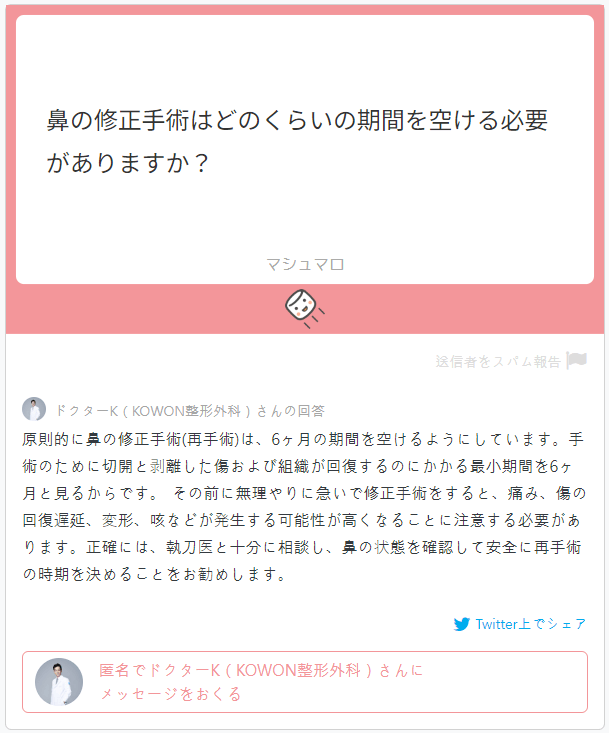
"I want revision rhinoplasty — how long does recovery take? Does revision usually take much longer?"
After one rhinoplasty, if the result disappoints, the first question is when the next surgery can happen. Especially the more the current state bothers you, the more "how much longer must I wait" comes first. Based on an actual question, this article organizes why revision timing is spoken of in terms of 6 months.
01
How long should I wait before revision rhinoplasty?
Cosmetic-purpose revision rhinoplasty is planned with time for tissue to stabilize, and 6 months is often used as a reference benchmark. But it isn't the same absolute minimum for every patient.
Here 6 months isn't a number meaning "anyone can be re-operated once that arrives." It's a benchmark arising because the wounds and tissue incised and dissected for surgery take a minimum period — seen as 6 months — to recover. As the phrase minimum period implies, the actual timing can differ by nose condition.
02
Why 6 months specifically?
Rhinoplasty goes through incising and dissecting skin and tissue. The wounds and tissue created in that process need time to recover again.
- Incised areas — even if the surface looks healed, inner tissue recovery can take longer.
- Dissected tissue — tissue lifted for surgery needs time to settle.
- Range of recovery — even at the same 6 months, recovery speed differs.
So 6 months is less the point where recovery ends than a lower bound approaching a state where re-operation can be discussed. What gets checked across revision overall is in the revision rhinoplasty guide.
03
If revision is done before 6 months, what should I watch for?
If you rush revision surgery before the period is filled, the following situations become more likely.
| What can appear when rushed | What it means |
|---|---|
| Pain | You end up touching tissue that's still recovering |
| Delayed wound healing | The previous surgery's wound-healing process can lengthen |
| Deformity | Because tissue hasn't settled, the shape can change |
Meaning: just because the current state bothers you, pulling the period forward doesn't favor the result. The order in which post-surgery recovery proceeds is in the recovery guide.
04
How is revision timing decided?
Precisely, we recommend consulting sufficiently with the operating surgeon, checking the nose's state, then deciding timing safely. Organized as an order:
- Check the 6-month benchmark first — confirm how long it's been since the last surgery.
- Consult the operating surgeon — the side that knows which surgery was done over what scope looks at the state.
- Check the nose's current state — directly confirm how far wounds and tissue have recovered.
- Decide timing — set the revision point to match the confirmed state.
05
Summary — the benchmark is state-checking, not the interval
In revision rhinoplasty, 6 months is a reference benchmark often used in cosmetic planning — but it's neither an absolute minimum at which all tissue has recovered nor an automatic surgery date. Surgery scope and scar·inflammation·skin state plus early-intervention need must be checked directly before timing is set.
If you're curious when revision can be discussed given your current nose state, get checked in a 1:1 video consultation.
Frequently asked questions
Answers to common questions patients ask before a consultation.
Once 6 months pass, can I get revision right away?
What problems can arise if I get revision before 6 months?
Who should I consult about revision timing?
Responses to treatment and recovery progress vary by individual. Outcomes and side effects vary from person to person. Bleeding, infection, swelling and asymmetry may occur. Please consult our medical team before making a decision.