
RIGHT-AFTER CASE BRIEFING
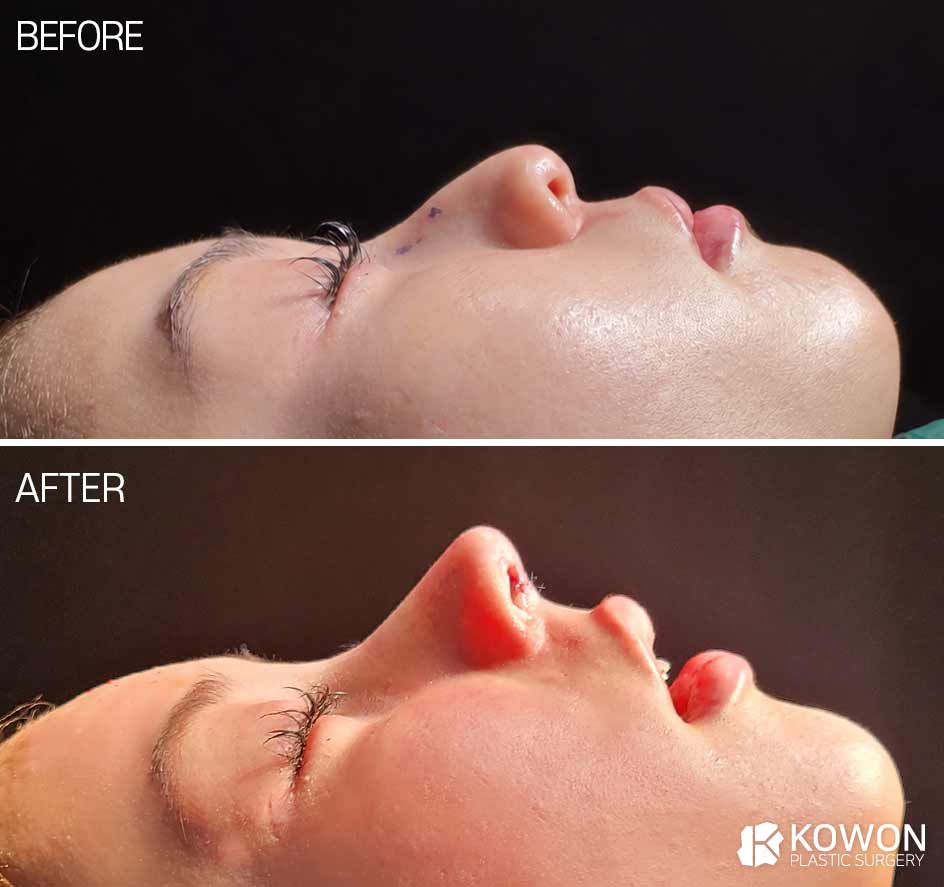
Low, humped and deviated nose corrected with autologous rib cartilage and septoplasty — immediately after rhinoplasty
Outcomes and side effects vary from person to person. Bleeding, infection, swelling and asymmetry may occur. Please consult our medical team before making a decision.
These KOWON Plastic Surgery rhinoplasty before-and-after photos, taken right after surgery, show the actual direction of change in a nose that was low, yet humped and bent, without an implant.
Hello, this is Dr. Kim Hyung-taek of KOWON Plastic Surgery.
This patient had a number of concerns from the very first consultation. First, the nose was low overall, yet the middle of the bridge stuck out like a hump, and the nose was bent to one side, so the nostrils looked different in size from the front.
The patient was also bothered that the area where the nose meets the philtrum was sunken, making the mouth look protruding. As for the bridge material, the patient was very unsure about silicone, so we put off the decision and held two consultations.
What if a low nose also has a hump?
A low nose and a hump nose seem like opposite problems, but they occur together more often than you might think. When the starting point of the nose at the glabella is low, even a slight bump in the middle of the bridge makes the hump stand out by comparison. With a nose like this, focusing only on shaving down the hump makes the nose look even lower and shorter, so the first step is to fill the glabella area and raise the starting point of the nose. Once the glabella is raised, the bridge can look smooth without much work on the hump itself. In these cases we either refine the hump slightly, or leave it and fill in the overall line and height instead.
Because this patient was very worried about silicone, I finely diced the patient’s own cartilage — the same cartilage used for the tip — and grafted it into the glabella.
Because it is the body’s own cartilage there is little concern about a foreign-body reaction, and it settles softly, without the feeling of something hard sitting on the bridge.
From long experience in rhinoplasty, I find filling with cartilage particles like this a particularly natural approach for someone who doesn’t need the bridge raised much.
Are a deviated nose and nostril asymmetry corrected together?
In most cases a deviated nose is caused by a bent septum — the central wall inside the nose. When the septum leans to one side, the whole nose follows it, and as the tip tilts, the nostrils become different sizes too. Straightening only the outside tends to let it bend again over time, so it is important to correct the deviated septum from the inside. Once the septum stands straight, the tip also tends to return to the centre, and the nostril asymmetry improves with it. Straightening a bent septum also widens the airway, so people who had nasal congestion often find breathing easier as well; where rhinitis is severe, rhinitis surgery can be done at the same time.
How this patient’s surgery was done
Using an open approach, I first straightened the bent septum. This step is what allows the tip built on top of it to sit in the centre.
The tip was set forward with autologous rib cartilage. In a low nose, filling the glabella and setting up the tip lets the hump on the bridge blend in naturally between them, giving a smooth, natural-glam line between straight and gently curved.
The splayed tip cartilages were brought together with tip-cartilage suturing to make the tip more defined.
Tip muscle correction was done as well. This patient had well-developed muscles that pull the tip down when smiling or talking, so I adjusted them so that the tip doesn’t droop and the philtrum doesn’t look long with expression.
Last came nasolabial angle correction. The angle where the nose meets the philtrum was sunken, which made the mouth look protruding; I filled this without an implant to soften the philtrum line running from the tip. If the nose is set up but the nasolabial angle is left as it was, the nose can easily look as though it is floating; correcting this angle at the same time helps the nose and mouth look as if they belong to one face, and makes the result look less operated-on.
In the photo taken right after surgery, you can see a single line from the glabella to the tip without a hump, and the profile has become tidier as the tip was set forward. The line of the nose could change like this without a single implant because three areas — the glabella, the tip and the nasolabial angle — were adjusted together with the patient’s own cartilage.
[OP PLAN]
- Diagnosis: low nose + hump nose + deviated nose (deviated septum), nostril asymmetry, sunken nasolabial angle
- Patient’s requests: improve the low nose and hump, straighten the deviation, improve nostril asymmetry, be cautious about using silicone
- Approach: open rhinoplasty (open incision)
- Septum: deviated-septum correction – correcting the cause of the deviation and nostril asymmetry
- Tip: tip set up with autologous rib cartilage + tip-cartilage suturing
- Bridge: diced cartilage graft to the glabella – raising the starting point of the nose without an implant to smooth the hump line
- Tip muscle: tip muscle correction – keeping the tip from drooping with expression
- Nasolabial angle: nasolabial angle correction without an implant
See this patient’s before-and-after photos 6 days after surgery
Right after surgery is the stage before the swelling really builds, so the bridge and tip lines and the change in the nose’s central axis created by the rhinoplasty can be seen relatively clearly.
KOWON Plastic Surgery starts from natural-looking change, but aims beyond a result that simply doesn’t show — for a “natural-glam” rhinoplasty that brings out the flow of the line and its details.
As recovery goes on, the swelling subsides and the tissues settle, and the tip takes on a softer, more natural shape than it has now. When the septum has been corrected, the inside of the nose can feel swollen and stuffy at first, but the airway opens as the swelling goes down. The chest area where the rib cartilage was harvested is left with a small incision mark, which fades over time and does not interfere with daily life. Rhinoplasty results can differ with each person’s skin thickness and cartilage, and the settled final result can be seen after a sufficient recovery period.